Friday, October 1, 2021

Finding the Right Therapist for You


I want to take a moment to talk to you about how not every therapist is the right therapist for you.

Having a therapist we can trust is an important cornerstone for social support network, and it is vital to our recovery from PTSD and moral injury. In counseling, this is called the therapeutic relationship, and it is incredibly important.

Healing from PTSD requires radical authenticity on our part and skill and expertise on the part of our therapist. It may take a while to find the right therapist for you, and that's okay. It doesn't mean that you are beyond help.

In 2008 when I was at my worst with my own PTSD, I was command-directed to see a psychiatrist. This was at a military treatment facility and the psychiatrist was a white male colonel. I was suicidal, vulnerable, and frankly, I was desperate. I didn't understand what was happening to me and I believed that I was going crazy. I talked with this psychiatrist for the better part of an hour, and then he said to me, "Virginia there's nothing I can do to help you if you can't be honest with me." I was bewildered. He then qualified his statement by saying, "women don't serve in combat and I can't help you if you're not telling me the truth."

I wish I were making this up. I was labeled with a personality disorder and my experience was completely dismissed. This took a terrible situation and made it worse.

I'm not sharing this story with you for pity; I'm sharing it for awareness. After I became a therapist myself, I found that the experience of being belittled and dismissed is more common than I could have imagined, especially for female military members, persons of color, and those who identify as part of the queer community. Even in the current environment of me too and racial reckoning, clients have reported to me that they have not been believed when they reported their experience during active service or after, even with a therapist. 

And I want to be very clear: that is absolutely not okay. There is no excuse for this behavior from a mental health professional. 

Jennifer Freyd, with the University of Oregon, researches and writes about institutional betrayal and I recommend her work to learn more about this. 

But I say all that to say this: some therapists are unprofessional or simply not good at their jobs. I'm not trying to be ugly; it is what it is. 

If a mental health professional chooses not to believe your experience, that probably says a lot more about them than it does about you. And I know the outcome can be devastating. 

I encourage you to advocate for yourself and keep leaning forward so that you can get the help you deserve to reclaim your life.

We've created a Free Workbook to help you identify your symptoms so that you can make an informed decision to reclaim your life from PTSD and Moral Injury.

*****

“If you believe change is possible, you want to change, and you are willing to do the work, you absolutely CAN get your life back.”

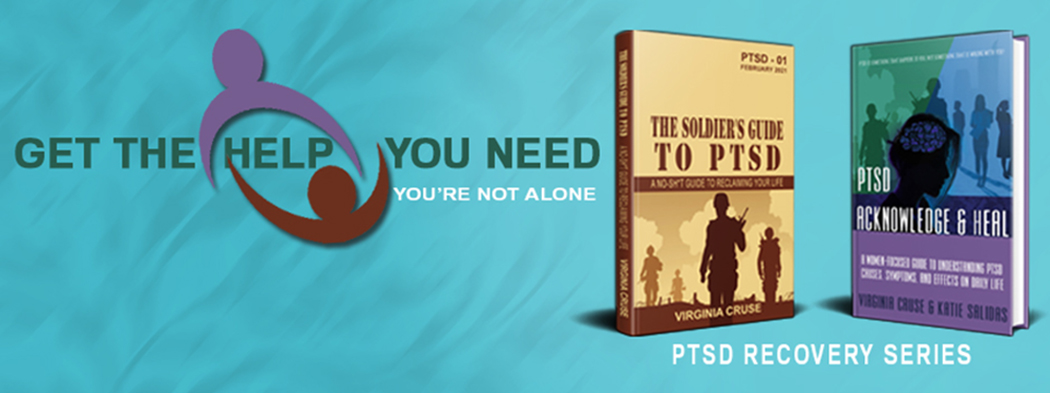
Get your copy of The Soldier's Guide to PTSD, The Soldier's Workbook, 

or Acknowledge & Heal, A Women's-Focused Guide to PTSD

Saturday, August 7, 2021

Soldier's Guide Book Tour and Giveaway


The Soldier's Guide is going on tour, pandemic-style! This month, we are on a blog tour and visiting readers across the great, vast interweb to talk about PTSD, Moral Injury, and effective treatment.

Our goal is to take PTSD and Moral Injury out of the shadows and start an authentic conversation that challenges stigma and shares experience, strength, and hope with those who have PTSD and the people who love and support them. Evidence-based treatments for PTSD are effective, available, and they work quickly - 8-12 sessions.

Now, this isn't JUST a book tour, it's also a giveaway, so stop by one of these blogs this week to enter to win!

First Prize: $50 Amazon gift card
Runner ups: $25 Amazon gift card (3 winners!)

Here are the links to the blogs and the days they will feature The Soldier's Guide to PTSD:


We would love to see you there!

*****

“If you believe change is possible, you want to change, and you are willing to do the work, you absolutely CAN get your life back.”

Get your copy of The Soldier's Guide to PTSD, The Soldier's Workbook, 

or Acknowledge & Heal, A Women's-Focused Guide to PTSD

Sunday, August 1, 2021

Reader Questions: Is PTSD Treatable?

Dear Virginia, 

I am a Veteran who served in Vietnam class of 68/69. My MOS was 8404 or fleet marine force Navy Corpsman attached to the US Marines. I also lead a support group for Veterans. I am in the process of reading your book and using it to stimulate conversations. Your book is aimed at younger Veterans and rightfully so. You say you can be cured. Two questions: first what is your interpretation of cured? The second is what about us older Veterans who held it in and practiced PTSD for 30-40 years? 
Thank You in advance.

Rich Jakubczak “Doc Jake“

Dear Doc Jake,

Thank you for taking the time to reach out to me; I value hearing from you. This is an opportunity to discuss what treatment can do and what it can't.

I'm going to start with the latter. Treatment does not mean that we will forget about our traumatic experience. I understand that this is our wish though, and I get it. Who wants to remember losing a buddy, being raped, being trafficked, or any number of traumatic events? Unfortunately, treatment for PTSD does not erase our memories. 

The purpose of treatment for PTSD is to reduce our symptoms. Intrusive memories, nightmares, avoidance, and hypervigilance can get to a point where they affect our walking, talking everyday lives — and we're not able to function the way we once used to. "Cured" means that our symptoms reduce to the point where we can function in our roles again effectively. 

The goal of treatment is not to change the past (I wish we could do that, but it's not a thing), but to get our symptoms under control to the point where they no longer screw with us daily. We can reclaim our lives and function in our roles — as a parent, a friend, an employee, a brother, or a battle buddy. 

I am especially thankful for your second question, especially because it is not something I thought to address directly in the book and I think it's important. YES, I have personally worked with my brothers and sisters who served during the Vietnam era, and they have experienced incredible success in reducing their PTSD symptoms; it is damned inspiring. 

Evidence-Based Treatments (EBTs) like prolonged exposure, cognitive processing therapy, and EMDR work for chronic PTSD. The data are clear; whether we've been dealing with our PTSD for five years or 50, EBTs work. 

The hardest part of treatment for chronic PTSD is answering the first of the Big 2 Questions: "Do I believe that I can recover from my PTSD, even if I've been carrying it for decades?" 

I know that recovery is possible for Vietnam-era Vets because the research is clear and because I have seen it myself. In your support groups, I imagine that you get to see some incredible breakthroughs as well. The bottom line is that YES — recovery is absolutely possible, and EBTs make it damned likely. 

THANK YOU, Doc — your continued service as a peer support group leader and leader in your community is inspiring.

Virginia


*****

“If you believe change is possible, you want to change, and you are willing to do the work, you absolutely CAN get your life back.”

Get your copy of The Soldier's Guide to PTSD, The Soldier's Workbook, 

or Acknowledge & Heal, A Women's-Focused Guide to PTSD