Showing posts with label Diagnosis. Show all posts

Friday, August 5, 2022

What is the DSM?

Fact: there is one only one way to get an official PTSD diagnosis, and that’s with a licensed clinician who knows their DSM-5. There is an updated version called the DSM-5-TR - the "TR" stands for "text revision."

The Diagnostic and Statistical Manual, Version Five, is a big purple book that should be on your therapist’s bookshelf with the title DSM-5 or DSM-5 on the spine. The version five came out in 2013, and this is important for you to know in case you got a diagnosis before 2013 - the clinical definition of PTSD changed significantly from version four to version five. 

The DSM-5 is the authoritative guide to the diagnosis of all mental disorders. It contains descriptions, symptoms, and criteria for diagnosis. I am stomping my foot for a reason: if I had a nickel for every client I’ve seen who said their base psych didn’t diagnose them with PTSD because they did not score high enough on a “test,” I’d have three or four bucks. There is no “PTSD test;” you have to have a no-kidding come-to-Jesus sit-down with a mental health professional. It takes time and effort. You have to choose to be radically authentic with the clinician, and the clinician has to know their DSM-V. Hence, there are a lot of misdiagnoses out there. 

Bottom line is that we all deserve to get our lives back, so find a clinician who understands your diagnosis.

What worked for you to get a proper diagnosis? We value your feedback and ideas! Reach out on our Community Facebook Page!

*****

If you believe change is possible, you want to change, and you are willing to do the work, you absolutely CAN get your life back.”

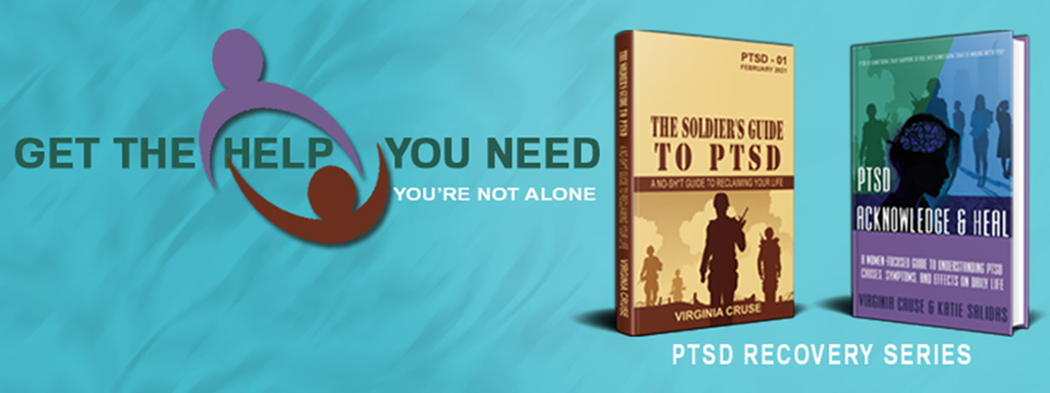
Get your copy of The Soldier's Guide to PTSDThe Soldier's Workbook

or Acknowledge & Heal, A Women's-Focused Guide to PTSD
Friday, April 15, 2022

Hallucinations & Flashbacks - an Expected Part of PTSD

As a clinician, I want to be straight with you: I have never seen a case of PTSD without hallucinations. Never. And we need to talk about this openly because hallucinations make us feel legit crazy in a way other symptoms don’t. Ditto for flashbacks.

What’s a Flashback? So glad you asked because flashbacks are nothing like we see in the movies. That would be nice, but real flashbacks are way worse. They are like waking talking nightmares; intense episodes that happen while we’re fully awake. Just like an intruder, flashbacks strike suddenly and feel uncontrollable. Flashbacks are more like a nightmare than a memory because sometimes we can’t tell the difference between the flashback and reality. They’re vivid and feel unbelievably real. Unlike a movie clip, in flashbacks we can see, hear, taste, and smell things. It’s fucking terrifying because it is like the trauma is happening all over again in the moment. Those of us who experience flashbacks often feel like we’re going crazy. You’re not; this is a PTSD symptom. 

When we don’t know that hallucinations and flashbacks are an expected part of PTSD, we can feel like we’re going crazy and very seriously consider suicide - and this makes a lot of sense. We stop feeling like we can trust our brains and our bodies and we can literally start becoming frightened of ourselves and our reactions. We start asking ourselves, “what if I hurt my family?” or “what if I lose my shit in the Walmart?” I very much get you; it can feel like we’ll never come back from this. But you will.

For now, just let this sink in: hallucinations and flashbacks are a normal part of PTSD. Normal doesn’t mean that it’s okay, it just means that hallucinations and flashbacks are common and not unexpected. This is par for the course; you are not a freak. 

Bottom line is that we all deserve to recover from our PTSD symptoms and get our lives back. Get the help you need.

*****

If you believe change is possible, you want to change, and you are willing to do the work, you absolutely CAN get your life back.”

Get your copy of The Soldier's Guide to PTSDThe Soldier's Workbook

or Acknowledge & Heal, A Women's-Focused Guide to PTSD

Monday, March 15, 2021

What Trauma Is - According to the DSM-5


Why do we care how the DSM defines trauma? Because the DSM-5 is the authoritative guide to the diagnosis of all mental disorders. It contains descriptions, symptoms, and criteria for diagnosis. 

The DSM-5 goes to great length to define trauma for us, and we are smart to tune in. It is important that we know our diagnosis better than anyone else, to include our therapist, our docs, or our chain of command. Do not expect any one else to care about your recovery more than you.   

There are five major criteria to PTSD that you need to know: A-E. F, G and H have to do with length of time, how much your PTSD is affecting you, and ruling out other factors (substances or other physical medical conditions). 

Criterion A. This criterion gives us the DSM’s definition of trauma: "actual or threatened exposure to death, serious injury, or sexual violence." 

So this is a big umbrella; there are many life events that could fit - not just combat. Being trafficked, bullied, beaten, molested, sexually abused or raped - natural disasters, school/church shootings, genocide, growing up in a dangerous place - this list could go on and on. Unfortunately, trauma is a ubiquitous experience in America. The data are clear: most of us have either experienced trauma ourselves or personally know someone who has. The brave #MeToo survivors are a recent example to highlight this.

Let’s talk about this term, “actual or threatened exposure.” We all have a physical and psychological reaction to threats: fight, flight, or freeze (freeze is the red-headed step-child of trauma, and more on that later). And your body and brain will react the same whether the threat is actual or threatened. So let’s say that you go on a convoy every day outside the wire, and that, thankfully, your convoy never gets schwacked. But you’re a smart cookie; you listen to your S2 and pay attention to the pre-briefs, you watch t.v., and you know that there are a lot of convoys that do get schwacked. Guess what? Your body and brain gears up every time you leave the wire whether you get schwacked or not - because your brain’s #1 job is to keep you alive. Your heart beats faster to get more blood to your muscles, your eyes dilate, you start to sweat or shake, and your brain gets you ready to stay alive no matter what.

But I never got schwacked, you say - I don’t deserve to have PTSD because I have my legs! Stop it. This is not how PTSD works (#ScienceMatters). When you run to the bunker during the incoming alarm, read the casualty reports, are walking back to your CHU alone in the dark, or literally dodge the bullet, you are still being exposed to the threat of death, serious injury, or sexual violence. PTSD doesn’t pick those who “deserve” it, so stop the bullshit cycle of self-blame you’ve been piling on yourself these last years.

Bottom line: we deserve to recover from trauma and there are solutions. Reach out to a clinician who understands your diagnosis and get the help you need.

*****

If you believe change is possible, you want to change, and you are willing to do the work, you absolutely CAN get your life back.”

Get your copy of The Soldier's Guide to PTSDThe Soldier's Workbook

or Acknowledge & Heal, A Women's-Focused Guide to PTSD

Monday, March 1, 2021

Learn More About Your Diagnosis


As Service Members or Veterans with PTSD, it is important that we know more about our diagnosis than anyone else - more than our therapists, our doctors, and our treatment team. At the end of the day, no one will be more invested in your recovery than you. It is vital that we understand PTSD inside and out - what it is, what it isn't, and how to come back from it. 

When we don't fully understand our diagnosis, PTSD can feel terrifying. But the truth is that PTSD is relatively common, and there are three VA-approved treatment methods that work 90% of the time: Prolonged Exposure (PE), Cognitive Processing Therapy (CPT), and Eye Movement Desensitization and Reprocessing (EMDR) (learn more here). And the truth is that those evidence-based treatments (EBTs) work for the long haul; PTSD does not "go into remission" like cancer only to strike us another day. 

There is misinformation galore about PTSD, even among treatment professionals, so it's time for us to get to work. 

*****

If you believe change is possible, you want to change, and you are willing to do the work, you absolutely CAN get your life back.”

Get your copy of The Soldier's Guide to PTSDThe Soldier's Workbook

or Acknowledge & Heal, A Women's-Focused Guide to PTSD

Sunday, December 15, 2019

What PTSD Is - and Is Not


There is a lot of information out there about PTSD, but it’s not very user friendly. It is written by clinicians for clinicians using psychobabble that doesn’t really help anyone. This is why the rumor mill about PTSD is so powerful. Before getting into the down and dirty facts on PTSD, it is smart that we discuss what PTSD is not right off the bat. 

In terms of background, this is what you need to know for now:


Post: means “after.” Trauma: exposure to death, serious injury, or sexual violence. This is something that happens to you, not something wrong with youStress: this is your body’s psychological and physical reaction to danger. Disorder: this is a clinical word that means your symptoms are getting in the way of your walking, talking everyday life - that’s all. It doesn’t mean you are FUBAR.


Now before we talk about what PTSD isn’t, I want you to know how I compiled this list: (1) from folks with PTSD, and (2) from actual masters and doctoral level clinicians whose job is to treat Soldiers with PTSD. So if you heard one of these and believed it was true, you’re in good company. (Put the judgment card away.) 


1. “PTSD has no cure.”

Add these themes: “I’ll always have PTSD,” “I’ll never get better,” and “the symptoms may go away, but the PTSD will always be there.” 


So, that’s not a thing. Not even a little. But it is a powerful belief so widely held that many folks give up before getting started. 


2. PTSD is only for military/combat/trigger pullers or “I don’t ‘deserve’ to have PTSD”

A lot of folks believe that only those who have served in military can have PTSD, and, within the ranks, this drills down further: “I can’t have PTSD because I never left the FOB,” or, “I can’t have PTSD because I never fired my weapon,” or, “I can’t have PTSD because my convoy never got schwacked.” 


So, that’s not a thing; that is fundamentally not how PTSD works. We’ll talk about this more in the next chapter, but suffice to say that your brain and body reacts the same way every time your convoy leaves the wire whether you get schwacked or not. That’s science. You don’t have to be a trigger-pulling, pipe-hitting mother-fucker for PTSD to whoop your ass. 


Then there’s, “I don’t deserve to have PTSD.” This often comes with, “at least I came home in one piece” or “at least my kids still have a father” or “my trauma wasn’t combat-related.” Let’s have some real talk: I don’t deserve to have the flu. I’m a really nice person and hella good looking. But flu doesn’t give a shit about that. No one deserves to have malaria or HIV or schizophrenia. But we don’t get a choice. 


PTSD is something that happens to you; not something wrong with you.


3. People with PTSD just aren’t resilient

Oh, resilience theory… Post-Traumatic Growth! Martin Seligmann, UPenn, and all that mandatory Comprehensive Soldier Fitness (CSF) training! Surely, the Army wouldn’t invest in training that was not evidence based!


But it did. And it hasn’t reduced Soldier suicide or PTSD. And the second and third order effects of CSF have made my job as a therapist harder because my mil clients believe that the reason they developed their PTSD was because there is something fundamentally wrong with them. 


4. People with combat-related PTSD were abused as children/have former trauma

I wish I were making this one up, but I hear it often enough from clinicians and especially from military officers. This compounds the idea that if a Soldier has PTSD not only are they not resilient enough, but it’s because they came into the Army as damaged goods. Because clearly no one who grew up in Mayberry could develop PTSD. 


So I hope it goes without saying that this is not a thing. When I challenge other clinicians, they are unable to cite studies other than, “well, I had this one patient…” Anecdotes, my friend, are not science. 


When I went searching for studies to support this idea, I found some research studies from the 90s that were inconclusive and recommended further research, but nothing definitive. As a clinician, I know this is garbage, but I have been impressed at how this lie hit the rumor mill and keeps on cranking. 


Confronting preconceived ideas about PTSD is important because we all deserve to recover from our PTSD and get our lives back. 


*****

If you believe change is possible, you want to change, and you are willing to do the work, you absolutely CAN get your life back.”

Get your copy of The Soldier's Guide to PTSDThe Soldier's Workbook

or Acknowledge & Heal, A Women's-Focused Guide to PTSD