Wednesday, December 15, 2021

Is PTSD Only for Military Members?


A rumor I often hear is that PTSD is only for military members, combat Veterans, or trigger pullers. Sometimes, I'll hear people say, "I don't deserve to have PTSD."

Many civilians believe that only military members can suffer from PTSD, and within the ranks many service members believe that only ops folks can have PTSD.

For military members, some of the things I hear time and again are, "I can't have PTSD because I never left the FOB," "I can't have PTSD because I never fired my weapon,"" or I can't have PTSD because my convoy never got schwacked."

So that's not a thing; that is fundamentally not how PTSD works. This is just a quick blog post, but suffice to say that your body and brain reacts the same way every single time your convoy leaves the wire, whether you get schwacked or not. You don't have to be a trigger pulling, pipe hitting, mother-trucker for PTSD to whoop your ass.

There's also the idea that PTSD is reserved for people who have "earned it." This often sounds like, "I don't deserve to have PTSD," "at least I came home in one piece," or "my trauma was a combat related."

Let's have some real talk for a minute. I don't deserve to have the flu. I'm a really nice person and I help people. The flu doesn't care about that. No one deserves to have malaria or HIV or schizophrenia, but we don't get a choice. PTSD is same-same.

Let's work together to dispel rumors about PTSD and encourage others to get the help they need to reclaim their lives.

*****

If you believe change is possible, you want to change, and you are willing to do the work, you absolutely CAN get your life back.”

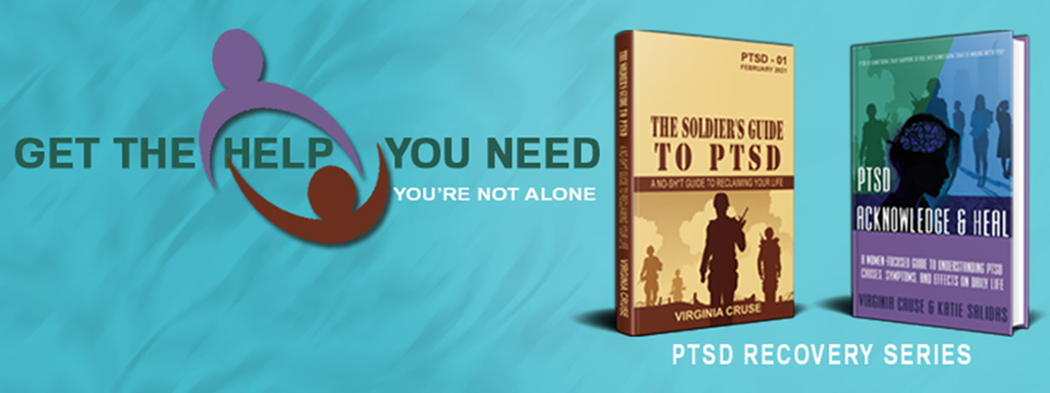
Get your copy of The Soldier's Guide to PTSDThe Soldier's Workbook

or Acknowledge & Heal, A Women's-Focused Guide to PTSD

Wednesday, December 1, 2021

#1 Rumor About PTSD that is Not True

"PTSD has no cure." This is the #1 rumor I hear from Veterans and even other clinicians. 

Add to this, "I'll always have PTSD and I'll never get better." 

This is such a widely held belief that many folks give up before getting started. The truth is that there are three evidence-based treatments for PTSD that are approved by the Department of Veterans Affairs at the time I am writing this: prolonged exposure, cognitive processing therapy, and EMDR. They've all been proven to work for most people.

It's important to use an evidence-based treatment for PTSD because evidence-based treatments are based on peer-reviewed, scientific evidence. This means that researchers conduct studies using scientific methods, document the research in peer reviewed scientific journals, and then other researchers conduct additional scientific studies to see if the treatment is, in fact, successful.

This is a lot like how drugs are tested by the FDA. Double-blind, randomized trials over a very long period with lots of scrutiny. When a therapy method is recognized as an evidence-based treatment, it's a big deal.

There are folks who are labeled as "treatment resistant," meaning that these three evidence-based treatments haven't worked for them. For this, researchers have found alternative treatments, like these MDMA-assisted psychotherapy, and faith-based treatments. 

The bottom line is it evidence-based treatments work most of the time for most people and it doesn't matter how you feel because that's science

Hear this. Nothing and no one can convince you something is true if you strongly believe it is not. That's science, too.

*****

If you believe change is possible, you want to change, and you are willing to do the work, you absolutely CAN get your life back.”

Get your copy of The Soldier's Guide to PTSDThe Soldier's Workbook

or Acknowledge & Heal, A Women's-Focused Guide to PTSD


Monday, November 15, 2021

Boundaries and PTSD


Healthy boundaries are the ultimate form of self-respect because they say to the world, I just deserve to be honored, respected, and valued. Boundaries denote confidence. 

Since confidence is one of the casualties of PTSD, we likely have to relearn (or maybe learn for the first time) how to make a healthy, reasonable boundary, how to maintain it, and what to do if someone chooses to ignore it. 

Making healthy boundaries seems like it should be easy and intuitive, but it's not. So let's start.

1. Healthy boundaries make healthy relationships

There is no such thing as a healthy relationship without boundaries, whether it's a marriage, a friend, a colleague, or the relationship that you have with your kids. Healthy boundaries say I deserve to be honored respected and valued and this is important for any healthy interpersonal relationship.

2. People do not know our boundaries unless we state them clearly and succinctly

In a perfect world, people should know how to act, but this is not a thing. Some people think that offensive comments are okay some people don't understand that unsolicited touching is creepy. Let's not waste time getting mad about what "should" be. Instead, let's remember that half the people we meet are below average and common sense is not common. Boundaries are not intuitive. Therefore, we must State our boundaries clearly and concisely, out loud, to other people.

3. Reasonable people respect reasonable boundaries

The inherent problem with this is that not all people are reasonable. Sad news of the day. The world is full of psychopaths and assholes. 

4. It's our boundary and their choice

We create healthy boundaries, and then we have absolutely no control over other people or how they act. When we state or healthy boundaries, out loud, clearly and concisely, other people then choose whether they want to respect our boundaries or not.

This is hard to hear, so I'm saying this with a lot of love and empathy: when people choose to ignore our reasonable boundaries, they are saying in no uncertain terms, loud and clear, I do not respect you and I do not want a relationship with you that is not on my terms. No exceptions.

Boundaries are vital to relapse prevention for PTSD. You can read more about boundaries in The Soldier's Guide to PTSD.

*****

If you believe change is possible, you want to change, and you are willing to do the work, you absolutely CAN get your life back.”

Get your copy of The Soldier's Guide to PTSDThe Soldier's Workbook

or Acknowledge & Heal, A Women's-Focused Guide to PTSD